iQube vs Chetak vs Rizta: Which Electric Scooter Leads in 2026?

Key Takeaways
- According to a September 2026 retail sales report published by Autopunditz, TVS Motor led electric two-wheeler registrations with 54,105 units, followed by Bajaj Auto (48,482 units) and Ather Energy (30,578 units).
- iQube vs Chetak vs Rizta price comparison puts the TVS iQube 2.2 kWh electric scooter in the most affordable price bracket, with the ex-showroom price starting at ₹94,434. Bajaj lists the Chetak C2501 at approximately ₹99,802, while Ather Energy introduces the baseline Rizta S at ₹1.21 lakh.
- The TVS iQube offers the highest certified IDC range of up to 212 km across its expansive battery options, while the Bajaj Chetak reaches up to 153 km and the Ather Rizta goes up to 161 km.
iQube vs Chetak vs Rizta: How Do Their Prices and Variants Compare?
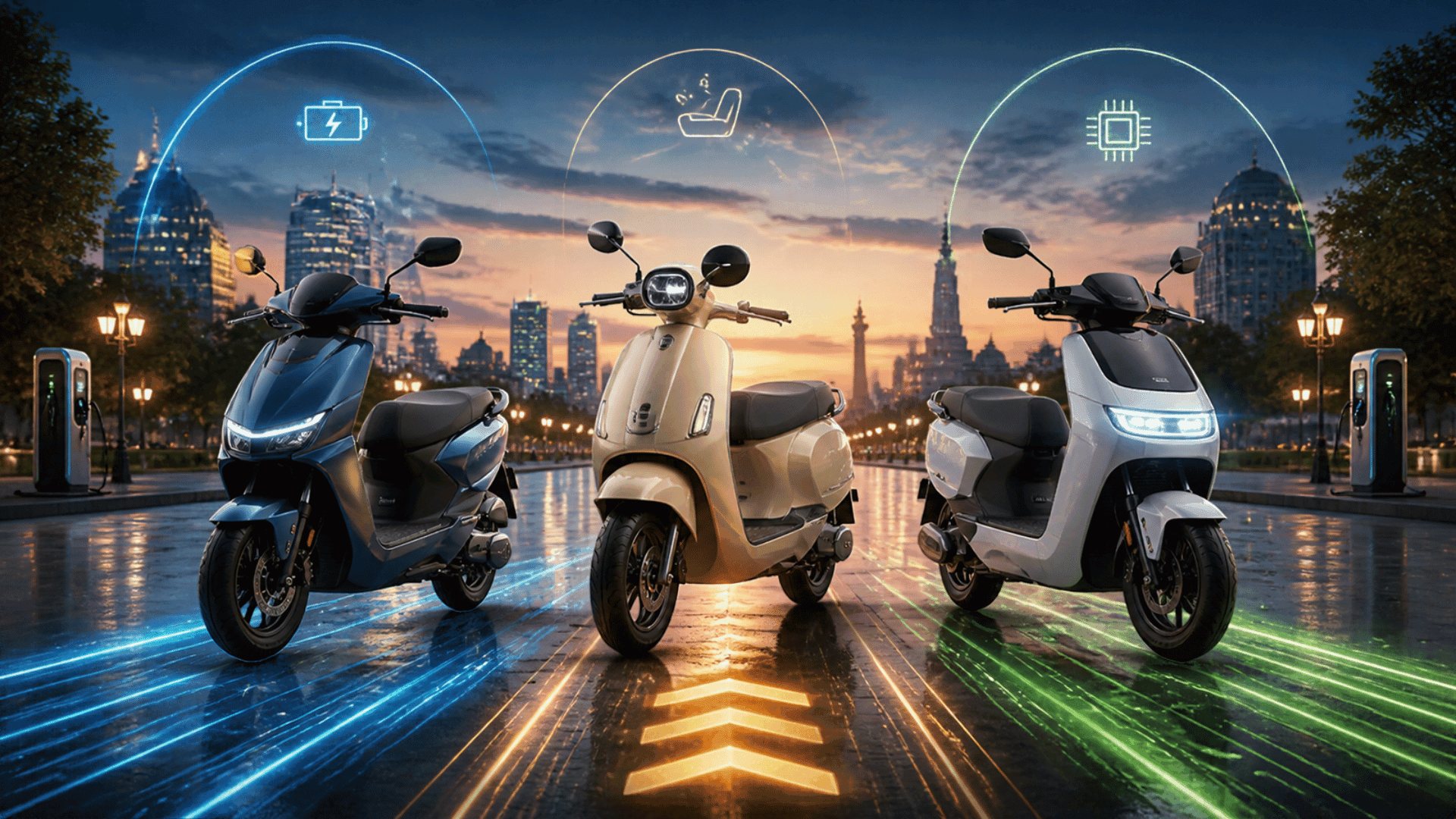
Comparing the TVS iQube, Bajaj Chetak, and Ather Rizta shows how different brands are designing electric scooters for Indian families. The TVS iQube is a practical daily scooter offering multiple battery options at an affordable price, starting at just ₹94,434. The Bajaj Chetak emphasizes a sturdy metal body and elegant retro styling, with its newest flagship top-spec model, the C3501, priced at ₹1.52 lakh. Meanwhile, the Ather Rizta focuses heavily on a larger floorboard and family-friendly design. Its baseline model, the Rizta S, comes at an ex-showroom starting price of ₹1.21 lakh.
| Parameter | TVS iQube | Bajaj Chetak | Ather Rizta |
| Variants | 2.3 kWh, 3.1 kWh, 3.5 kWh, MillionR Edition, S 4.7 kWh, ST 5.3 kWh | C2501, C3001, C3501, C3502, C3503 | Rizta S, Rizta Z |
| Ex-showroom Starting Price | ₹94,434 | ₹96,400 | ₹1.21 lakh |
| Higher Variant Ex-showroom Price | Up to ₹1.75 lakh | ₹1.52 lakh | ₹1.57 lakh |
iQube vs Chetak vs Rizta: Battery Specifications, IDC Range Compared
All three electric scooters use refined motors specifically designed for city riding. The TVS iQube lineup offers multiple battery options, from 2.3 kWh to 5.3 kWh lithium-ion battery packs, with certified IDC ranges between 114 km and 212 km. The Bajaj Chetak electric scooter lineup comes with three main battery options: the Chetak C2501 with a 2.5 kWh battery and IDC range of 113 km, the Chetak C3001 (Series 30) with a 3.0 kWh battery and IDC range of 127 km, and the Chetak C3501, C3502 and C3503 (Series 35), featuring a 3.5 kWh battery pack with IDC ranges between 151 km and 153 km.
The Ather Rizta electric scooter lineup features 2.7 kWh, 2.9 kWh, and 3.5 kWh battery packs across both Rizta S and Rizta Z models, offering certified IDC range between 123 km and 161 km.
| Parameter | TVS iQube | Bajaj Chetak | Ather Rizta |
| Battery Capacity Options | 2.2 kWh, 3.1 kWh, 3.5 kWh, 4.7 kWh, 5.3 kWh | 2.5 kWh, 3.0 kWh, 3.5 kWh | 2.7 kWh, 2.9 kWh to 3.5 kWh |
| Claimed IDC Range | Up to 212 km | Up to 153 km | Up to 161 km |
| Charging Time | 10-80% in 3 hours 45 minutes (3.5 kWh) | 0-80% in 3 hours 15 minutes (3.5 kWh) | 0-100% (home charging) in 7 hours 25 minutes/4 hours 30 minutes |
| Max Power & Torque | 4.4 kW & 140 Nm | 4.2 kW & 20 Nm | 4.3 kW & 22 Nm |
| Acceleration | 0 to 40 kmph in 4.2 to 4.7 seconds | 0 to 40 kmph in about 4.7 seconds | 0 to 40 kmph in 4.7 seconds |
| Top Speed | 68 kmph to 82 kmph | 60 kmph to 80 kmph | 80 kmph |
iQube vs Chetak vs Rizta: Which Scooter Wins on Comfort & Smart Connectivity Features?
When evaluating family electric scooters, daily usability depends heavily on cargo space, comfort, and digital integration. From generous under-seat storage compartments to advanced smartphone connectivity and rider safety aids, here is how iQube vs Chetak vs Rizta compare.
TVS iQube
- Features a well-padded, flat seat with a smooth telescopic front fork and hydraulic twin-tube rear shock absorbers to ensure a comfortable ride on rough city streets.
- Offers a generous under-seat storage space of up to 32 litres to hold daily essentials and utility items.
- Comes equipped with a high-resolution TFT touchscreen display that features geo-fencing, live vehicle tracking, music controls, and Alexa integration via SmartXonnect Technology.
- Offers Q-Park Assist across all variants, with hill-hold assist included as an added convenience feature on select models.
Bajaj Chetak
- Features a sturdy steel body and a comfortable seat, measuring 1,914 mm in length with a seat height of 775 mm, making it ideal for daily long-distance rides.
- Features a front glove box alongside a secure under-seat compartment for carrying everyday items.
- Comes equipped with a 5.5-inch digital TFT display with Bluetooth pairing, geo-fencing, call management, over-the-air updates, and keyless functionality.
Ather Rizta
- Features a 900 mm long, cushioned seat alongside a spacious flat floorboard designed for optimal legroom and rider comfort.
- Offers a large under-seat storage compartment with a capacity of up to 34 litres, paired with an optional front trunk to easily carry groceries and daily essentials.
- Features an advanced smart dashboard powered by AtherStack 7 and an Android Open Source OS, supporting turn-by-turn navigation, ride analytics, and smartphone app integration.
- Features AutoHold, Reverse Mode, and Magic Twist for easy riding and safe parking.
- Offers essential safety features, including SkidControl, FallSafe and Crash Alerts to prevent slides, cut power to the motor after a fall, and send alert notifications to the rider’s contacts.
Choosing a winner among iQube vs Chetak vs Rizta comes down to your priority, range preference, desired connectivity features, and budget. The TVS iQube comes across as the clear winner due to its battery choices, affordable pricing, and highest claimed IDC range of 212 km. The Bajaj Chetak suits buyers who prefer a sturdy metal body and classic styling. Meanwhile, the Ather Rizta stands out for its generous storage, family comfort, and advanced safety features.
FAQs
Which EV is better, iQube or Chetak?
Both the TVS iQube and the Bajaj Chetak rank among the top-selling electric scooters in India. The iQube stands out for its practicality, design, high performance and claimed IDC range (up to 212 km). Meanwhile, the Bajaj Chetak excels in build quality and larger storage of up to 25 litres.
What is the claimed range of the Bajaj Chetak 3501?
The Bajaj Chetak offers a certified IDC range of 127 km on a single charge through its 3.0 kWh battery pack.
Can I get a 4.7 kWh battery on the TVS iQube?
Yes, TVS offers a 4.7 kWh battery option on its iQube S 4.7 kWh variant, delivering a claimed IDC range of up to 175 km on a single charge. With this battery pack, the scooter charges from 10% to 80% in 3 hours and 15 minutes.
iQube vs Chetak vs Rizta, which scooter delivers the maximum power and torque?
The TVS iQube delivers 4.4 kW of power and 140 Nm of torque, which is higher than the Bajaj Chetak (4.2 kW & 20 Nm) and the Ather Rizta (4.3 kW & 22 Nm).
Ather Rizta vs TVS iQube, which has skid control?
Ather Energy offers SkidControl, also known as traction control, on the Rizta Z variant, preventing wheelspin on low-traction or slippery surfaces. The TVS iQube does not have this feature.