Best Bikes for First Time Riders: Mileage & Upkeep Costs
 By Anjani ChaandSeptember 16, 202610 min read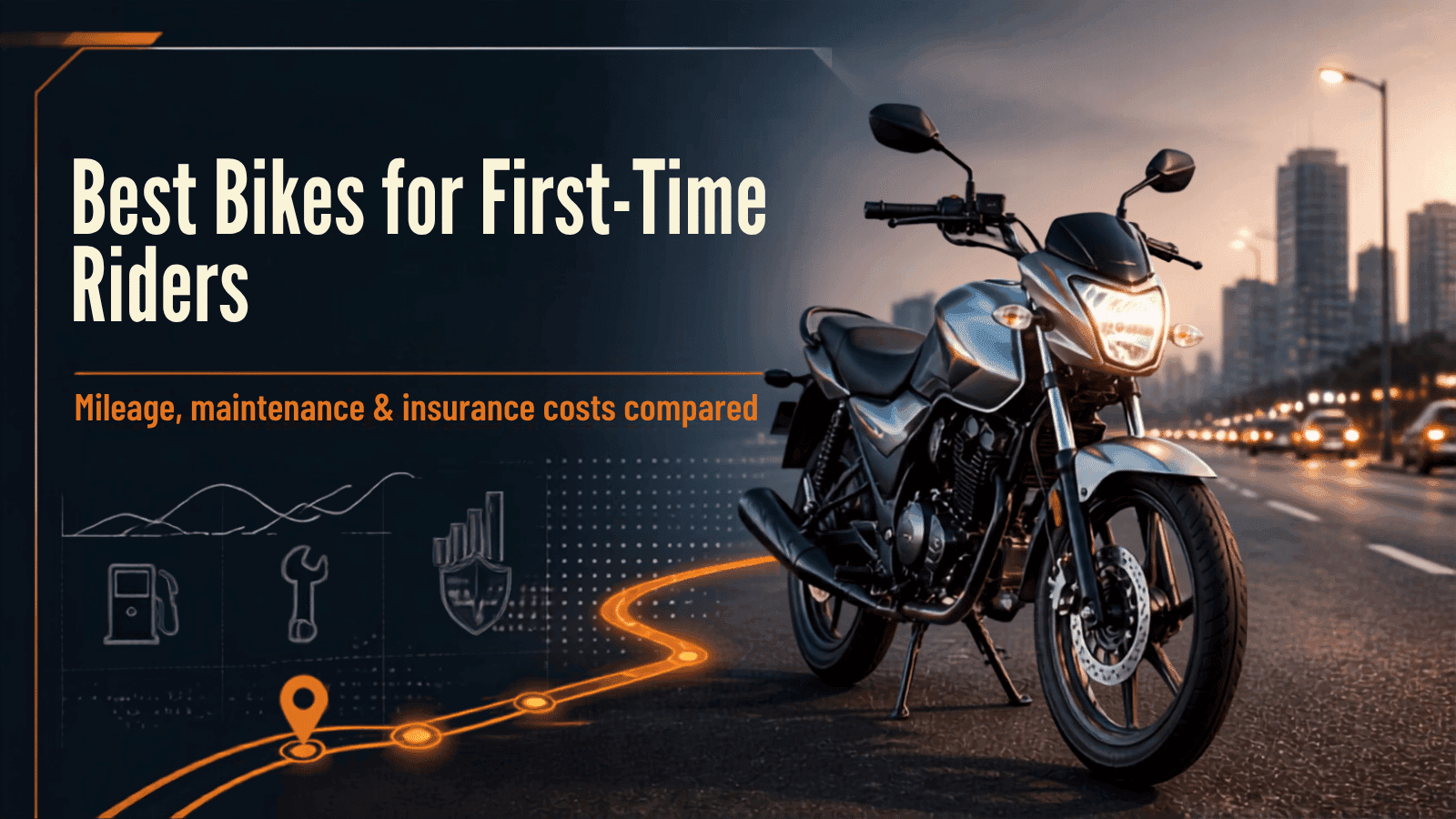
Key Takeaways
- The Hero Splendour Plus and Honda Shine 125 rank among the best bikes for first time riders in India for being lightweight and offering good mileage. TVS Raider 125 is a good pick for buyers who are more tech-focused. For a sportier look and modern features packed in a 160 cc engine, the Bajaj Pulsar N160 is the preferred choice.
- What makes it the best pick for a first bike is its low kerb weight (ideally below 140 kgs) and a power-packed 110-160 cc engine. As a new rider, it is easier to take control of a lightweight two-wheeler when commuting on busy city roads where you need to take sharp turns at a controlled speed.
- Normally, a 110–125 cc vehicle delivers 50–70 kmpl of mileage in city traffic, which over a period of a year would cost around ₹1,800–₹2,800 for servicing. The ownership cost of a 160 cc variant is slightly higher, at ₹3,500–₹4,500, mainly due to its synthetic oil and disc brake components.
- Bikes with engine capacity above 150 cc require higher insurance premiums because a more powerful engine produces more speed, increasing the risk of accidents and demanding more money for damage repair.
What Makes a Good First Bike for Beginners in India?
A good bike for beginners should feel easy to ride and control rather than superfast or flashy. Balancing on a bike that weighs under 140 kgs and comes with a 110-160 cc engine is much easier, as it prevents low-speed drops and keeps the acceleration smooth and manageable as you ride through heavy city traffic.
What Matters Beyond Price for a First Bike: Key Ownership Costs to Consider
While purchasing the best bikes for first time riders in India, you should look beyond just the price tag. While the purchase price reveals what you pay at the time of delivery, ownership costs, like real-world mileage, routine servicing, and annual insurance renewals, determine your two-wheeler’s affordability in the long run.
Even a low-budget bike can become surprisingly expensive if it requires frequent repairs, pricey spare parts, or heavy insurance premiums. First-time riders often tip over while parking or taking turns at slow speed. Choosing a bike with solid crash guards, wider handlebars, and cheaper, easily replaceable body panels not only saves you money on repair bills but also reduces stress when minor accidents occur. Check the total cost of owning a bike in India beyond just the ex-showroom price.
Real-World Mileage Compared for Popular Beginner-Friendly Bikes
When owning a bike, fuel costs turn out to be the biggest daily expense. Smaller 110 cc commuter bikes give you the best mileage, saving money. Larger 125-160 cc variants use up more fuel to deliver faster speeds on highways, increasing the overall expense.
Compare ARAI-claimed vs real-world mileage before picking the best bikes for first time riders in India:
| Bike Model | Engine Displacement | ARAI Claimed Mileage | Real-World Mileage |
| Hero Splendour Plus XTEC 2.0 | 97.2 cc | 73 kmpl | 60 – 70 kmpl |
| Honda Shine 125 | 123.94 cc | 54.96 kmpl | 50 – 55 kmpl |
| TVS Raider 125 | 124.8 cc | 56.7 kmpl | 55 – 60 kmpl |
| Bajaj Pulsar N160 | 164.82 cc | 60 kmpl | 44 – 48 kmpl |
What Maintenance Costs Look Like for Beginner-Friendly Bikes in India
If you purchase a 110-125 cc bike (such as the Hero Splendour Plus or the Honda Shine 125), your annual maintenance cost covering 10,000 kms would be around ₹1,800-2,800. If you pick a 160 cc two-wheeler (for example, the Bajaj Pulsar N160), the yearly service bills may rise to ₹3,500-4,500.
Routine maintenance of a 110-125 cc bike is more affordable because they rely on an air-cooled engine. Highly efficient bikes feature complex cooling radiators or pricey parts, which adds to the cost.
- Routine Service Intervals: Manufacturers strongly recommend that first-time riders get their first service done within the first 30-60 days, or between 500-750 kms, whichever is earlier. A routine service typically includes cleaning or replacing the air filter, changing the engine oil, cleaning the spark plug, and adjusting the drive chain. Following the initial service, the second service should be scheduled around 4-5 months, or between 2,500-3,500 kms.
- Basic Consumable Costs: For 100-125 cc bikes, the standard cost per litre for mineral or semi-synthetic engine oil roughly varies between ₹350 and ₹550. A pair of brake pads costs around ₹250 to ₹500, while a new drive chain costs between ₹800 and ₹1,400.
- Accidental Damage Repairs: The cost of replacing a bent clutch lever or a footpeg on a commuter bike at an authorized service centre goes up to ₹200-₹400. Restoring plastic body panels on heavier, sporty bikes is relatively expensive.
How Insurance Costs Vary by Bike Type, Model, Engine Capacity
Bike insurance premiums vary based on the specific model, variant, and engine capacity, among other factors (such as coverage type, IDV, location, theft risk, etc.). Understanding the engine cubic capacity (cc) slabs beforehand helps you plan your insurance premiums better during annual renewals.
- Engine Capacity: Your bike’s engine cubic capacity (cc) determines how much premium you pay towards insurance renewal. The higher the engine capacity, the more powerful the bike and the greater the chances of an accident. This directly impacts your annual insurance premiums. The Insurance Regulatory and Development Authority of India (IRDAI) uses fixed cubic capacity slabs (such as under 75 cc, 75–150 cc, 150–350 cc, and above 350 cc) to set mandatory third-party insurance premiums.
- Bike Type & Risk Profile: Standard commuter bikes have a low risk profile due to moderate speed, resulting in lower Own Damage (OD) and third-party rates. On the other hand, performance or sports bikes are more prone to accidents, which increases OD rates. Premiums for touring bikes or cruisers are higher because they carry add-ons (such as engine protection and zero depreciation) due to long-distance travel.
- Bike Model & Market Value: Higher-end models, typically priced over ₹1-1.5 lakh, have a higher IDV (Insured Declared Value). If the vehicle gets stolen or damaged beyond repair, the insurer pays out a larger claim, which directly increases the annual OD premiums.
Get a detailed breakdown of two-wheeler insurance types and coverage before purchasing your first bike.
Best Bikes for First Time Riders in India: Price, Features, & Verdict Compared
The Hero Splendour Plus, TVS Raider, and Honda Shine 125 are some of the best bikes for first time riders. These have a low kerb weight, deliver good power output, and are low maintenance. Before choosing, compare the ex-showroom prices, standout features suitable for first-time buyers, and drawbacks.
Hero Splendour Plus XTEC 2.0
Ex-Showroom Price: ₹83,414
Why It Is Best for First-Time Buyers
- Easy to balance because of its light weight (112 kg)
- Features an Integrated Braking System (IBS), side stand engine cut-off, and hazard lights for rider safety
- Delivers an impressive 70 kmpl real-world mileage backed by Hero’s i3S idle stop-start technology
- Features a fully digital instrument console with Bluetooth call/SMS alerts, a Real-Time Mileage Indicator (RTMI), and a built-in USB charging port.
Limitations
- Uses a traditional 4-speed transmission
- Lacks disc brakes on the front wheels for sharper stopping
Honda Shine 125
Ex-Showroom Price: ₹87,081
Why It Is Best for First-Time Buyers
- Comes with a refined eSP engine & 5-speed gearbox for minimal vibrations during daily commute
- Features a Silent ACG Starter & Idling Stop System for noiseless engine start and automated engine power cut when travelling short distances
- Features a Combi-Brake System (CBS) with equalizer for improved stability and short stopping distances
- Comes equipped with a fully digital console and modern features such as a 15W USB-C charging port and a side-stand engine cut-off for safety.
Limitations
- Features a basic hydraulic rear suspension that feels soft on deep potholes when carrying a heavy pillion
- The standard variant comes with 130 mm front and rear drum brakes
- The 123.94 cc engine offers decent mileage but lacks strong highway performance
TVS Raider 125
Ex-Showroom Price: ₹83,910
Why It Is Best for First-Time Buyers
- Features a 5-step adjustable monoshock suspension on the rear wheels to absorb road bumps, making the ride smooth
- Comes equipped with an IntelliGO Auto Stop-Start feature that automatically turns the engine off to save fuel in traffic
- Features a 5-inch digital/ TFT console with gear position indicators, turn-by-turn navigation, call alerts, and a side-stand engine cut-off so new riders can avoid riding with the stand down or stalling in the wrong gear.
Limitations
- The sportier seating posture and slightly leaning riding position feel less relaxed compared to other upright commuter bikes
- The base variant relies on 130 mm drum brakes on both wheels with Synchronized Braking Technology (SBT)
Bajaj Pulsar N160
Ex-Showroom Price: ₹1,22,106
Why It Is Best for First-Time Buyers
- Comes with a dual-channel ABS paired with a large 300 mm front disc brake to prevent locking of wheels on wet city roads or during sudden stops
- Features a bi-functional LED projector headlight and LED DRLs for better night visibility
- Has a monochrome LCD console with Bluetooth connectivity, gear position indicator, turn-by-turn navigation, and a built-in USB charging port.
Limitations
- For a beginner, the price range falls in the slightly higher bracket.
- The body weighs 152–154 kgs due to a wider frame, making it slightly difficult to park or maneuver at low speed.
- The maintenance cost goes slightly higher due to synthetic oil requirements and pricier disc brake pads
Picking your first-ever bike requires balancing a light bodyweight and smooth power delivery against long-term ownership costs, such as fuel, servicing, and insurance. Evaluate real-world fuel economy, safety features, comfort and tech advancements beyond ex-showroom prices for a memorable first-time riding experience!
Frequently Asked Questions (FAQs)
What is the ideal engine size for a first-time bike rider?
Best bikes for first time riders should ideally have an engine size of 110-125 cc is considered the safest balance. This power range delivers good rather than aggressive speed in city traffic while preventing unpredictable jerks when you push the accelerator.
How much should a beginner budget for yearly bike maintenance?
Beginners riding a 110-125 cc commuter bike should plan a budget between ₹2,000 and ₹4,000 for annual service and maintenance (such as engine oil changes and basic wear-and-tear parts).
Is single-channel or dual-channel ABS necessary for beginners?
An ABS (Anti-lock Braking System) is recommended for first-time riders, as it prevents wheels from locking under hard braking. While a single-channel ABS on the front wheels is good for protection against front-end skids, a dual-channel ABS is desirable for better safety on wet roads.
Why are insurance premiums higher on 160 cc bikes compared to 125 cc bikes?
Insurance premiums are higher on 160 cc bikes compared to 125 cc bikes mainly because the IRDAI regulations classify the former under a higher cubic capacity and risk bracket, demanding higher third-party and Own Damage rates.
Should I buy a 110 cc bike or a 125 cc bike as my first motorcycle?
If you commute through heavy city traffic at low speed daily or frequently, then a 110 cc bike is a better choice as it offers maximum mileage and is low-maintenance. If your daily commute route includes ring roads, flyovers, or highway stretches, then a 125 cc bike is preferable. It delivers the extra power for safe overtaking while saving fuel.