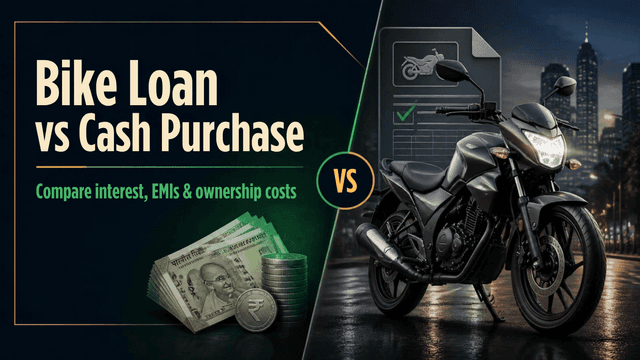
Bike Loan vs Cash Purchase: Which Should You Choose?
 By Anjani ChaandSeptember 29, 20266 min read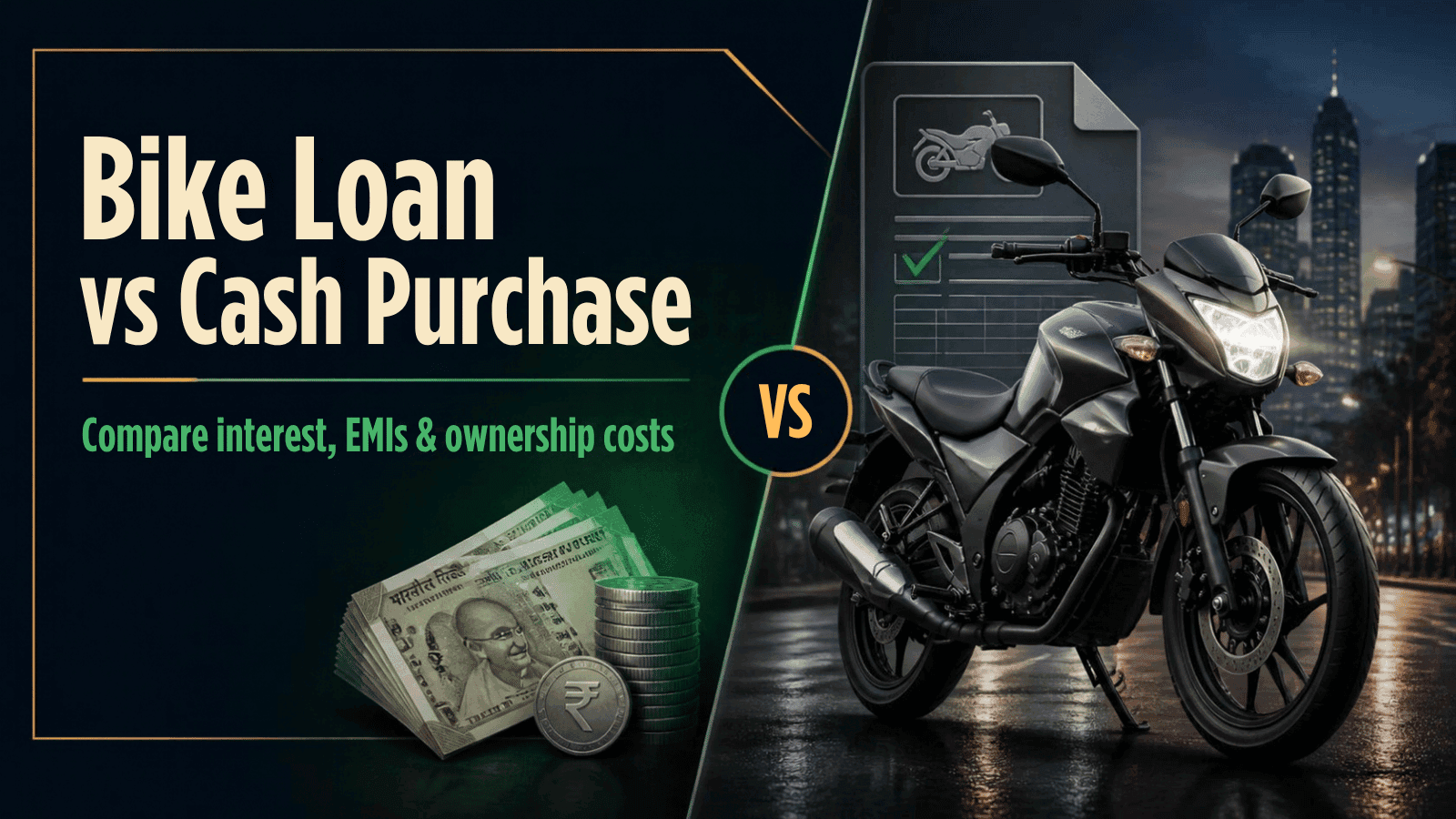
Key Takeaways
- Evaluating your upfront budget, cash liquidity, and total interest costs is crucial when deciding whether you should take a bike loan vs cash purchase.
- A bike loan surely reduces the initial cash outlay, keeping your savings reserved for emergencies. You can comfortably repay the amount through easy monthly EMIs over the next 1-4 years.
- Most banks charge around 17% to 18% per annum for two-wheeler loans. This increases the total interest payout at the end of the tenure. Paying in full upfront is a more sensible choice if you want to avoid these charges.
- Financed two-wheelers remain hypothecated to the bank until the entire loan is repaid. After the loan closure, you would require a No Objection Certificate (NOC), Form 35, and RTO processing fees to take legal ownership of the bike.
Bike Loan vs Cash Purchase: Cost & Ownership Comparison
For first-time buyers, deciding between a bike loan vs cash purchase comes down to balancing three financial aspects. This includes liquid cash in hand, current two-wheeler interest rates, and investment returns. Paying in full cash means you don’t need to pay any interest charges or processing fees, and it skips the mandatory vehicle hypothecation recorded on your Registration Certificate. On the other hand, a bike loan ensures you don’t splurge all your savings on a purchase and allows you to spread out your payments in smaller monthly installments (EMIs) over 12-48 months.
For instance, the Honda Shine 100 is priced at ₹65,642 ex-showroom in Delhi. Paying the full amount would eliminate interest and borrowing fees. However, if you finance the full ex-showroom amount through a 2-year bike loan at a rate of 9% p.a. instead, you would be paying a total interest of approximately ₹6,330. In addition, there will be processing fees over the repayment tenure.
| Parameter | Full Cash Purchase | Bike Loan |
| Upfront Outflow | 100% of the on-road price | Usually 10%–20% down payment depending on the lender (or up to 100% funding on select models) |
| Interest Expenses | ₹0 | Typically 17%–18% per annum on standard two-wheeler loans (varies by lender) |
| Additional Charges | ₹0 | 1%–2.5% processing fee, stamp duty, and documentation fees |
| Vehicle RC Status | Clean ownership title under your name | Hypothecated to the bank until the final EMI is paid |
| Resale / Transfer Ease | Direct transfer at the RTO anytime | Requires a Bank No Objection Certificate (NOC) and RTO HP removal |
| Emergency Fund Impact | High immediate cash depletion | Low immediate cash depletion; preserves liquid funds |
You may also choose to pay a partial amount as a down payment to balance it out. Most banks accept a 10-20% down payment and finance the remaining amount. Check this detailed bike loan down payment guide to know how much you should pay upfront.
Key Financial Factors to Consider Before Deciding a Bike Loan vs Cash Purchase
While choosing between a bike loan vs cash purchase, it is essential to evaluate the total interest, cost of ownership, emergency reserves, and hypothecation. This will help you not financially straining yourself.
Total Interest & Ownership Cost
- Interest Burden: Interest rates levied on two-wheelers are relatively higher than auto loans or home loans. While public banks, like the SBI, charge a standard 11.70% to 15.70% interest rate per annum, private banks like HDFC two-wheeler interest rates start at 14.50% p.a.
- Mandatory Bank Charges: When you take a bike loan, banks typically charge a non-refundable processing fee between 1% and 2.5%, alongside stamp duty fees and documentation charges.
- Advantage of a Cash Purchase: Buying in full cash completely saves you from a high interest payout, leaving you with the lowest possible purchase price.
- Real-World Impact: A loan of ₹1 lakh at 11% to 13% would incur interest and processing fees of approximately ₹18,000-₹20,000 over 3 years.
Liquidity Management & Emergency Savings
- Conserving Liquidity: Paying upfront in cash takes out a large chunk of your bank balance, leaving you vulnerable in case of a financial or medical emergency.
- Financial Flexibility: By taking a bike loan, you can save your hard-earned money and even invest it elsewhere to get higher returns.
- Ideal Cash Buyer: A cash purchase works well for buyers who have at least 6 months of savings or a separate emergency fund to cover essential monthly expenses.
Hypothecation, Ownership, and Resale Flexibility
- Registration Certificate Endorsement: The Registration Certificate of a financed bike has “Hypothecated to XYZ Bank” printed on it. This means the bank has a legal claim to the newly purchased bike and can use it as collateral until you repay the loan amount.
- RTO Endorsement Fees: After paying off your bike loan, you must submit Form 35 and a NOC to your local RTO along with a fee of up to ₹100-₹500 to remove the hypothecation from your Registration Certificate.
- NOC Requirement: After paying off the bike loan, you would require a No Objection Certificate (NOC) from the bank to remove hypothecation in case you want to sell or transfer ownership of the two-wheeler.
When to Choose Bike Loan vs Cash Purchase?
You should select the right payment mode depending on your monthly income, job stability, and current cash reserves. You could explore affordable bikes under ₹1 lakh before deciding on a bike loan vs cash purchase. The decision should be based on whatever suits your budget and convenience.
Go for a cash purchase if you have enough savings or an emergency fund to fall back on, want to avoid monthly EMI burden, and plan to take complete legal control of your two-wheeler from the very first day.
Opt for a bike loan if you want to save cash in hand, build a solid credit history, and prefer smaller, manageable monthly payouts rather than a lump sum.
FAQs
Is it better to buy a bike on loan or cash?
A full cash payment is generally cheaper because you skip interest charges and additional fees. But it also depends on whether you have a financial safety net. If you do not have enough savings or a backup fund to cover unforeseen expenses, then opt for a bike loan.
Is a bike loan better for first-time buyers?
Yes, for first-time buyers, a bike loan is generally a practical choice for first time buyers because it helps build credit history while lowering upfront costs.
What should I check before taking a bike loan?
You should check the loan interest rate, tenure, EMI processing fees, penalty charges, prepayment charges, total interest cost, and APR, where applicable, before taking a bike loan.
Does buying a bike on loan affect its resale value?
A financed bike does not itself lose its resale value, but since it remains hypothecated to the bank, you must settle the loan and remove the hypothecation to transfer ownership.
What is the biggest disadvantage of taking a bike loan?
The biggest disadvantage of financing a bike is that the total amount paid may exceed the actual purchase cost over time because of cumulative interest and applicable loan charges. If you opt for a longer tenure, the total interest cost will also increase.