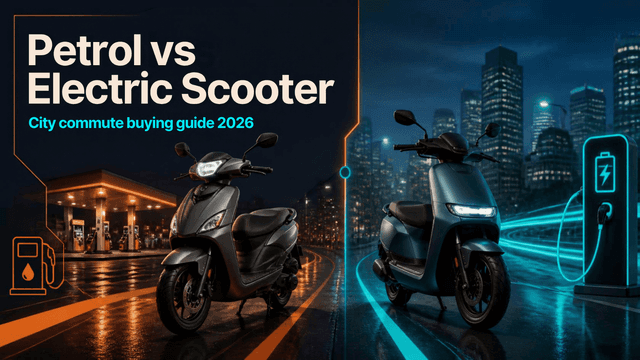
Petrol vs Electric Scooter for City Commute: 2026 Buying Guide
 By Anjani ChaandSeptember 28, 20266 min read
Key Takeaways
- If you compare petrol vs electric scooter for city commute, you must note that petrol scooters suit buyers who travel longer distances regularly and have to rely on public gas stations for quick refuelling. Electric scooters are an excellent choice for those who travel within 15-20 km and have a dedicated home charging setup at home.
- Although petrol scooters cost less than electric scooters initially, 5-year maintenance costs for replacing air filters, changing the engine oil, and checking the spark plugs go up to ₹15,000. EV scooters eliminate these costs, but replacing lithium-ion batteries post-warranty is much more expensive, often covering 40-60% of the vehicle’s ex-showroom price.
- Petrol vs electric scooter city commute running cost differs. Petrol scooters cost about ₹2-2.50 per kilometre, whereas EV scooters cost roughly ₹0.20-0.30 per kilometre to run, making them nearly 90% cheaper for daily commuting.
Petrol vs Electric Scooter for City Commute: Which is Better for You?
Choosing between petrol vs electric scooter city commute depends on how far you ride daily. A petrol scooter makes sense if you travel long distances or do not have reliable access to charging. An electric scooter is a better option if you usually take predictable, short trips across the city every day and have access to home charging.
Although EVs are priced slightly higher than regular petrol variants, the price gap has narrowed in 2026. The popular TVS Jupiter 125cc petrol baseline model (Drum Alloy) is priced at ₹97,240 (Delhi on-road), while its electric variant, the iQube (2.3 kWh battery pack), costs ₹1,02,421 (Delhi on-road).
Before buying, you should compare petrol vs electric scooter city commute not just based on pricing, but on factors such as refuelling, long-distance flexibility, routine powertrain maintenance, etc.
| Parameters | Petrol scooter | Electric scooter |
| Entry price | Usually lower across mainstream models | Competitive on some entry variants |
| Energy cost | Depends on petrol price and mileage | Depends on electricity tariff and consumption |
| Refuelling | Fast and widely available | Requires charging time |
| Home infrastructure | Not required | Charging access is important |
| Apartment use | Straightforward if parking is available | Removable-battery models can simplify charging |
| Long-distance flexibility | Strong due to quick refuelling | Depends on range and charging network |
| Routine powertrain maintenance | Higher mechanical complexity | Fewer conventional powertrain components |
| Range certainty | Fuel stations provide quick recovery | Real-world range varies with conditions |
Key Cost Differences in a Petrol vs Electric Scooter for City Commute
Before picking a petrol vs electric scooter city commute, evaluating the upfront acquisition costs against daily fuel expenses and long-term convenience is important. Petrol scooters are more affordable and refuel quickly at any station. EV scooters cost more and require access to designated charging points, but save money on fuel due to their lower per-kilometre running costs. Compare the cost differences between a 125cc petrol scooter and an urban electric scooter.
Daily Fuel vs. Electricity Running Expenses
- Running Cost for Petrol Scooter: The entry-level TVS Jupiter 125 petrol scooter claims ARAI mileage up to 50 kmpl. With petrol priced at ₹100 per litre in metro cities like Delhi, daily travel expenses would cost approximately ₹2 per km.
- Running Cost for Electric Scooter: The TVS iQube electric scooter delivers an IDC-claimed range of up to 114 km on a single charge. Charging a 2.3 kWh battery scooter requires roughly 2.5 units of electricity, costing approximately ₹20 for a full charge.
- Monthly Savings: Travelling 30 km daily on the TVS Jupiter 125 petrol scooter costs around ₹1,800, compared to just under ₹165 on the iQube 2.3 kWh electric scooter. This could save you approximately ₹1,635 per month.
- Limitations for Petrol Scooty Owners: Fluctuations in fuel costs directly increase your commuting expenses over a standard 5-year ownership period.
Maintenance and Service Upkeep
- Maintenance of Petrol Scooters: Petrol scooters require servicing, like engine oil changes, air filter replacements, spark plug checks, and CVT drive belt maintenance at regular intervals.
- Maintenance of Electric Scooters: Since EV scooters run on batteries, the main focus remains on regular servicing of brake pads, tyres, and suspension rather than internal combustion components.
- 5-Year Maintenance Cost: Scheduled routine servicing over 5 years typically costs around ₹1,2000-1,5000 for a 125cc petrol scooter compared to around ₹6,000-8,000 for urban electric scooters.
- Limitations for EV Scooty Owners: Replacing the battery of an electric scooter after the warranty period (typically 5-7 years) is expensive. An out-of-warranty EV battery can cost up to 40-60% of the scooter’s original ex-showroom price, depending on the brand and capacity.
Upfront Pricing vs Refuelling Convenience
- Upfront Price Gap: Electric scooters usually cost more upfront than petrol scooters because of expensive lithium-ion batteries. TVS Motors lists its Jupiter 125 Drum Alloy at an ex-showroom price of ₹81,700 in Delhi. The iQube, with a 2.3 kWh battery, starts at ₹95,124.
- Refuelling Speed: Having a front-mounted external filler, the Jupiter 125 refills its 5.1-litre fuel tank in just 2 minutes at any petrol pump, offering quick range recovery for longer rides.
- Home Charging: The iQube 2.3 kWh can power up from 0-80% in 2 hours and 50 minutes using its portable off-board 950W charger that easily plugs into a standard 15A wall outlet.
- Limitations for EV Scooty Owners: Buyers residing in an apartment without a dedicated charging setup may find it difficult to plug in their electric scooters for overnight charging.
Weigh all pros and cons before finally deciding between petrol vs electric scooter city commute. Electric scooters are more suited for short-distance travel under 15-20 km. They provide eco-friendly transport for low-mileage trips with no need for pricey fuel and complex maintenance. Petrol scooters remain a more practical choice for long-distance city commuting. They come at a lower price tag, offer good mileage and quick refuelling, so you need not worry about a home charging setup.
FAQs
Which is better for long-distance commuting petrol vs electric scooter?
Yes, petrol scooters are generally considered for commuting long distances because they offer a much higher range per tank and a quick refuelling option compared to EV scooters.
Which requires less maintenance between petrol vs electric scooters?
Yes, electric scooters require significantly less maintenance because they do not use an internal combustion engine. There’s no need for air filter replacement, fluid and engine oil changes, so the expenses are limited to fixing brake pads, tyres, and suspension. But EVs still require periodic checks on their electrical systems and battery.
Can an electric scooter handle monsoon waterlogging?
Many modern electric scooters come with IP67-rated battery packs and motors, designed to endure heavy rainfall and temporary waterlogging during monsoon.
Are petrol scooters still better for resale value?
Popular 110-125cc petrol scooters still retain roughly 50-60% of their original value after 3 years due to strong market demand, especially in Tier 2 and Tier 3 cities where fueling infrastructure is more reliable compared to EV charging networks.
How many kilometres should I ride before considering an EV?
You should consider buying an electric scooter if your daily commute is between 15 km and 30 km, or your monthly running exceeds 500 km. They are highly cost-effective and can significantly reduce per-kilometre running costs compared to petrol scooters.